Transform your Card Payments platform with Worldline software
01 / 09 / 2021
Discover our modern Card Payments solution, part of our core processing and powering top Financial Institutions. Based on an open architecture, with a rich API catalogue and designed for industrial processing. Interested to know how we can sustain the economic growth of your company?
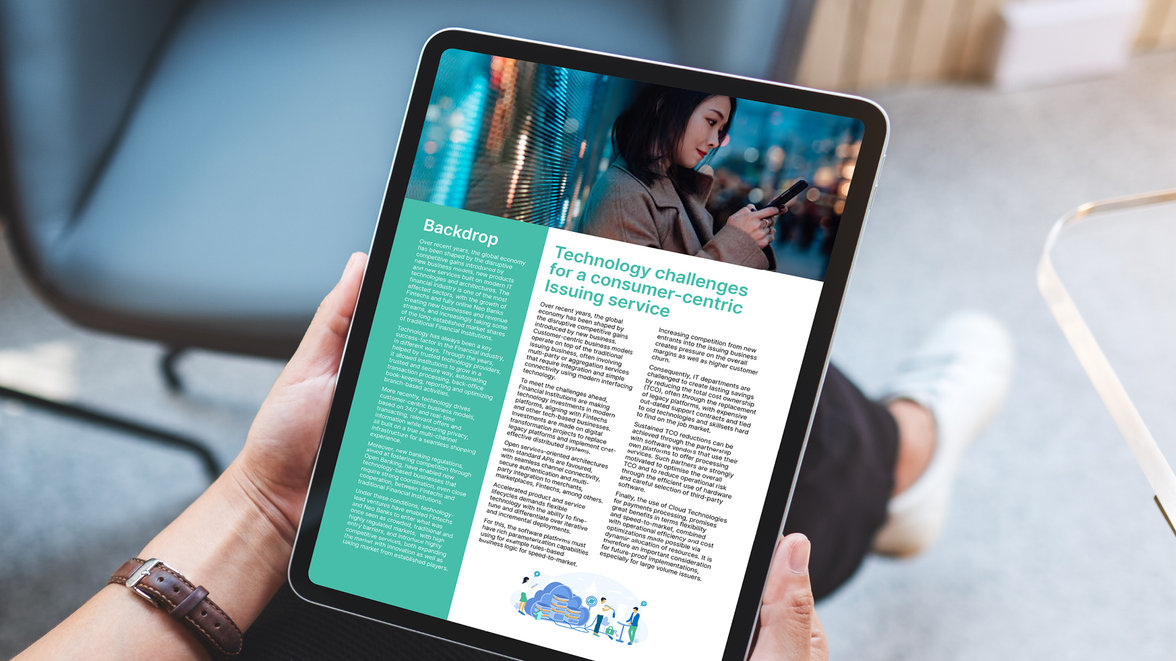
Backdrop
Over recent years, the global economy has been shaped by the disruptive competitive gains introduced by new business models, new products and new services built on modern IT technologies and architectures. The financial industry is one of the most affected sectors, with the growth of Fintechs and fully online Neo Banks creating new businesses and revenue streams, and increasingly taking some of the long-established market shares of traditional Financial Institutions.
Technology has always been a key success-factor in the Financial industry, in different ways. Through the years, helped by trusted technology providers, it allowed institutions to grow in a trusted and secure way, automating transaction processing, back-office book-keeping, reporting and optimizing branch-based activities.
More recently, technology drives customer-centric business models, based on 24/7 and real-time transacting, relevant offers and information while securing privacy, all built on a true multi-channel infrastructure for a seamless shopping experience.
Moreover, new banking regulations, aimed at fostering competition through Open Banking, have enabled new technology-based businesses that require strong coordination, even close cooperation, between Fintechs and traditional Financial Institutions.
Under these conditions, technologylead ventures have enabled Fintechs and Neo Banks to enter what was once seen as crowded, traditional and highly regulated markets, with high entry barriers, and introduce highly competitive services, both expanding the market with innovation as well as taking market from established players.
Technology challenges for a consumer-centric Issuing service

Over recent years, the global economy has been shaped by the disruptive competitive gains introduced by new business. Customer-centric business models operate on top of the traditional issuing business, often involving multi-party or aggregation services that require integration and simple connectivity using modern interfacing technology.
To meet the challenges ahead, Financial Institutions are making technology investments in modern platforms, aligning with Fintechs and other tech-based businesses. Investments are made on digital transformation projects to replace legacy platforms and implement costeffective distributed systems.
Open services-oriented architectures with standard APIs are favoured, with seamless channel connectivity, secure authentication and multiparty integration to merchants, marketplaces, Fintechs, among others.
Accelerated product and service lifecycles demands flexible technology with the ability to finetune and differentiate over iterative and incremental deployments.
For this, the software platforms must have rich parameterization capabilities using for example rules-based business logic for speed-to-market.
Increasing competition from new entrants into the issuing business creates pressure on the overall margins as well as higher customer churn.
Consequently, IT departments are challenged to create lasting savings by reducing the total cost ownership (TCO), often through the replacement of legacy platforms, with expensive out-dated support contracts and tied to old technologies and skillsets hard to find on the job market.
Sustained TCO reductions can be achieved through the partnership with software vendors that use their own platforms to offer processing services. Such partners are strongly motivated to optimise the overall TCO and to reduce operational risk through the efficient use of hardware and careful selection of third-party software.
Finally, the use of Cloud Technologies for payments processing, promises great benefits in terms flexibility and speed-to-market, combined with operational efficiency and cost optimizations made possible via dynamic allocation of resources. It is therefore an important consideration for future-proof implementations, especially for large volume issuers.
Worldline Issuing Platform
| Solution functions | API | Authorization Card Issuing | Fraud Management, Account Management | Clearing & Settlement, Product Management | Dispute Management | API |
| Product types | Credit | Installments | Prepaid | Debit | Deferred Debit | Charge |
| Consumer offering | Virtual Card | Digital Wallet | Instant Issuance | Promotions | Dynamic Card Control, Forex Card | Salary Card, Buy Now Pay Later |
| Delivery model | Processing | Software as a Service | Hosting | Cloud | Licensing | |
| Partner ecosystem | Open APIs | Ecosystem integration | Digital use cases | Value-added services | ||
| Business benefits | Speed to Market | Differentiation | Competitive edge | Customer Retention | Customer Growth |
Issuing Backoffice

Key Features
- Rules-based configuration through own scripting language
- Card products and Contract Management
- Card Management: technology, personalization data, relationship to customers and accounts, activation, renewal, re-issue
- Customer data
- Account Management - support debit, prepaid, charge and revolving credit
- Service definition: type of transactions allowed, restrictions and exceptions
- Card and Account issuing fees
- Open Architecture - Linux
- Multi-node distributed clustered architecture at application level as well as database level for High Availability and Scalability
- Support for International Card Schemes Clearing processing and Dispute Management
Issuing Backoffice

Key Features
- Support for International Card Schemes
- Rules-based configuration through own scripting language
- Configurable Transaction Workflow
- Flexible Authorization methods - Stand-alone Authorization, Stand-in to host with Store and Forward and fully online authorization
- Open Architecture – Linux
- Multi-node distributed clustered architecture at application level as well as database level for High Availability and Scalability
- Active-Active deployments
- PA-DSS compliant
Would you like to learn more?
Simply fill in a few details and our experts will get in touch.