Ready for agentic commerce.

New buying journeys need payments built on trust.

Agentic commerce payment on mobile during flight
Payment complete
Identity verified

Agentic commerce is here: AI agents that search, compare and buy on behalf of people and businesses, changing how consumers shop and how companies serve them. That shift is already moving wallet share, customer loyalty and payment flows, and it's only accelerating.

Worldline connects agent-driven journeys to the payment ecosystem that merchants, banks and consumers already rely on. Securely. Verifiably. Across Europe.

What is agentic commerce?

Agentic commerce is a form of digital commerce in which an AI agent can support or carry out parts of a buying journey on behalf of a consumer or business.

An agent may help search, compare and select an option. With the right instructions and approval, it may also initiate or support the payment. That changes more than the customer experience. It changes what payment infrastructure needs to recognise, authenticate, authorise and record.

What changes

Traditional ecommerce vs. agentic commerce

Traditional ecommerce

Agentic commerce

Who searches & chooses

The customer browses and decides

An AI agent searches, compares and shortlists on the customer's behalf

The moment of choice

On the merchant's site or app

Increasingly within the agent, before the merchant is reached

How merchants win

SEO, UX, brand, conversion design

Being discoverable and transactable by agents, and chosen by them

What payments must verify

That a human initiated the transaction

That the transaction reflects what the customer approved, whoever initiates it

Authentication

Customer authenticates directly at checkout

Consumer approval and authentication must travel with the agent

The bank's role

Authorises a human-initiated payment

Stays central to authentication, authorisation and trust, participating differently, not removed

Customer relationship

Direct between merchant and customer

Mediated by the agent, making trust and recognition essential

What's at stake when customers shop with agents?

When an AI agent does the searching, comparing and buying, the moment of choice moves. That changes the economics for everyone on the journey.

The opportunity is real on both sides. So is the risk of waiting. Worldline is the partner helping merchants and banks turn this shift into an advantage - without rebuilding what already works.

When an agent enters the journey, trust has to travel with it.

Connecting agent-driven journeys to trusted payment infrastructure.


Worldline is connecting emerging agent-driven experiences to the payment ecosystem that merchants, banks and consumers already rely on.

What does agentic commerce mean for you?

The implications differ for merchants, financial institutions and ecosystem partners. Start with the pathway that reflects your role.

From discussion to live European transactions.

Agentic payments aren't a concept on our roadmap. They're running on European infrastructure today. Worldline has completed live, end-to-end agent-driven transactions with leading banks and payment networks across multiple European markets.


Crédit Agricole proof point - The first agent payment in France

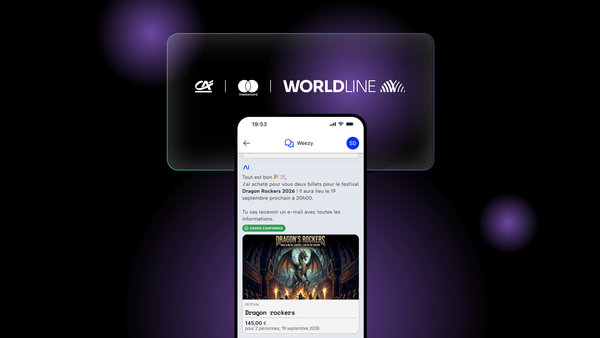
Worldline, Crédit Agricole and Mastercard completed the first agent payment transaction in production in France. A Crédit Agricole customer searched for festivals through a digital agent by setting up a budget, event type and location; the agent proposed options; and the customer confirmed before any purchase was made. Crédit Agricole, as issuing bank, retained authentication and authorisation. The flow ran end-to-end on Worldline's infrastructure, interacting with the Mastercard network, with specific identifiers ensuring transparency and traceability across the payment chain.

Read full press release

With this first agent-based payment transaction in France, Crédit Agricole confirms its innovation strategy in service of its customers. As a bank, we play a key role in guaranteeing secure, traceable and fully controlled payment journeys, adapted to future purchasing experiences — while maintaining a high level of trust in the payments ecosystem.

Philippe Marquetty, CEO, Crédit Agricole Payment Services


These proof points demonstrate how trusted agent-driven payments can work in practice as the wider ecosystem continues to develop.

We've been working on this since 2021.

Built around the way European payments work.

Europe has distinct regulatory requirements, payment methods, banking structures and consumer expectations. Agentic payments have to respect all four from the start.

See agentic commerce, live, in Paris.

The best way to understand what agentic commerce means for your business is to experience it. Our Innovation & Experience Centre in Paris runs a live, end-to-end agentic journey, from a customer's prompt to a payment Europe can trust, followed by a working session tailored to your role.

2026 sessions are filling up fast. Reserve yours while dates are still open.

FAQ

  • Agentic commerce is a form of digital commerce in which an AI agent can support or carry out parts of a buying journey on behalf of a consumer or business. An agent may help search, compare and select an option. With the right instructions and approval, it may also initiate or support the payment.

  • An agent-driven payment is a payment journey in which an AI agent participates in initiating or supporting a transaction, based on instructions or conditions set by a consumer or business.

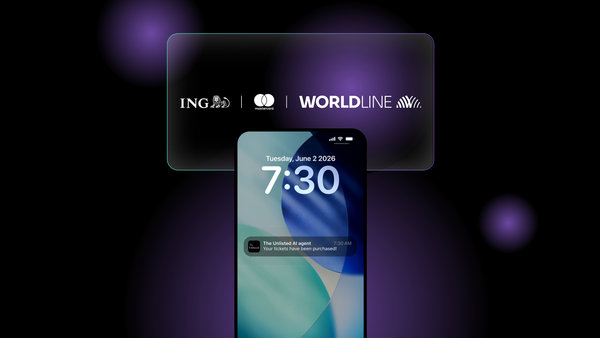
  • Yes, as live, production proof points Worldline has completed end-to-end agent-driven payments with ING and Mastercard, with ING and Visa, and with Crédit Agricole and Mastercard, across multiple European markets. These show the payment layer can operate through established infrastructure today. Broader commercial availability is still developing, and will depend on continued alignment between merchants, banks, payment networks, technology providers and regulators.

  • Never. The models Worldline has demonstrated are designed around consumer instructions and approval. The agent supports or acts within defined conditions, while the bank retains authentication and authorisation. We're also exploring how agents could make more autonomous purchases without direct involvement of the customer, based on high-level intent.

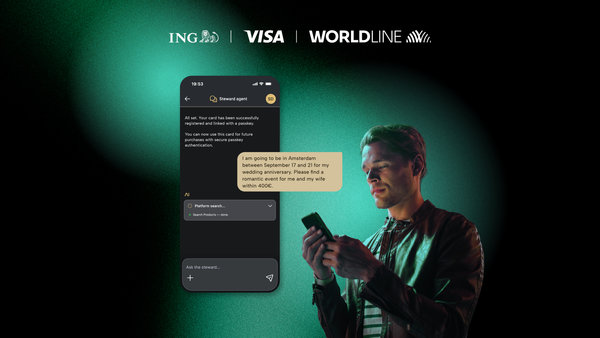
  • SCA stays relevant when an AI agent participates in a payment journey. The consumer still needs an appropriate way to authenticate and approve the transaction, and the issuing bank retains control over authorisation. In Worldline and ING's work with Visa, the consumer confirmed purchase intent biometrically using Visa Payment Passkey, supporting a journey designed around established authentication requirements.

  • Biometric authentication gives the consumer a familiar, low-friction way to confirm a purchase within an agent-driven journey. In Worldline and ING's work with Visa, Visa Payment Passkey was used to authenticate the consumer's purchase intent.

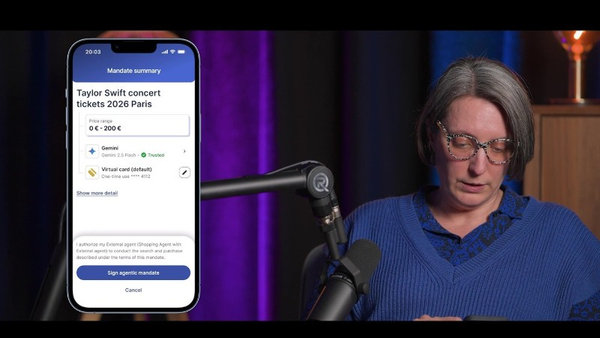
  • A merchant needs a clear, verifiable record of what the customer approved — the product or service, merchant, amount, timing and any other conditions. The payment journey should preserve this approval context so the bank and other participants can understand what was authorised, by whom and under which conditions.

  • An agent-driven transaction may need additional context alongside standard payment data: how the agent participated, what the customer approved, the applicable purchase conditions, the authentication event and the final outcome. This supports issuer decision-making, traceability and dispute handling.

  • AI agents shouldn't need access to raw payment credentials. Tokenisation can replace sensitive card information with payment tokens used within controlled journeys. Authentication, token controls and secure processing keep the agent separate from the underlying card credentials.

  • Agent-driven payments should operate within the security, authentication, fraud management and regulatory controls used for digital payments today. New risks can arise from unknown agents, altered instructions or unusual transaction behaviour. The consumer's approval, agent and transaction signals, issuer controls and a clear record of the journey all help manage them.

  • Agent-driven payments continue to use established payment rails and their dispute processes. The key difference is the potential need for additional evidence showing the agent's role and the conditions the customer approved. The exact allocation of liability depends on the payment method, scheme rules, contractual arrangements and applicable law.

  • Yes, some models already support delayed completion within clearly defined conditions. In the Visa transaction Worldline and ING demonstrated, the model allowed completion up to 48 hours after authorisation. In future, agents may complete transactions with greater autonomy based on a customer's high-level intent.

  • Merchants may need to make products and buying journeys understandable to AI agents, while keeping checkout, approval and payment confirmation reliable and secure.

  • Banks may need to process new transaction information, authentication patterns and risk signals, while retaining control over authorisation and consumer protection.

  • Yes. Worldline began researching agent-initiated payments in 2021 and continues to publish on the topic. Worldline experts co-authored AI Agents in Payments: Applications, Risks and Regulations with HEC Paris, published in the European Journal of Risk Regulation by Cambridge University Press.

  • Worldline is currently working with ecosystem partners to test and develop the payment capabilities agent-driven commerce needs. The live transactions are proof points and shouldn't be read as broad commercial availability.

  • Yes. The Worldline MCP Server connects our payment functionality to AI agents through the Model Context Protocol, so developers can build and test AI-powered payment workflows using natural-language prompts. It's available now via our developer portal, ConnectAI, as a first building block toward agent-initiated payments.